Best AI Tools for Automating Daily Work Faster
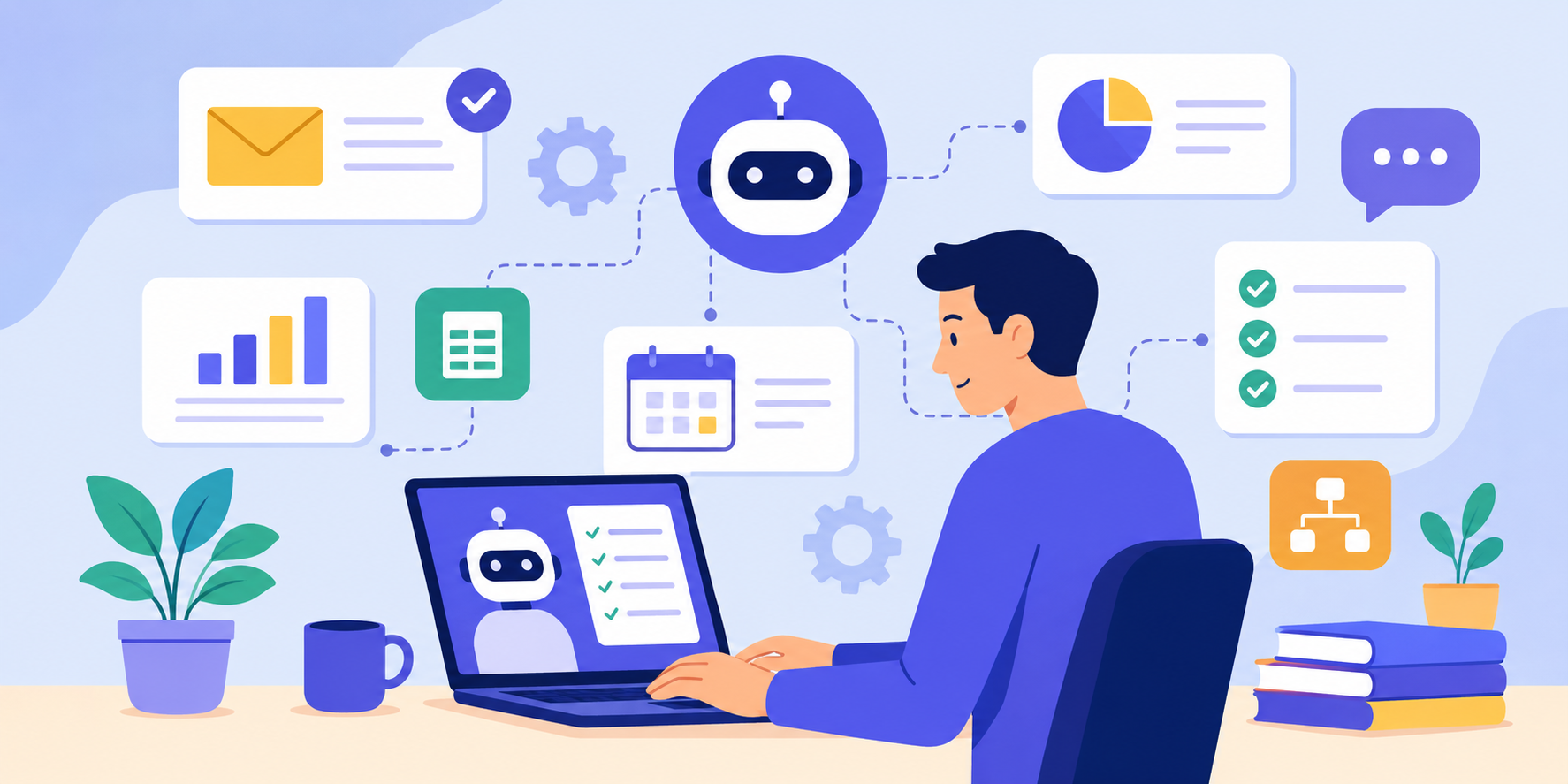
Artificial intelligence is rapidly changing how businesses handle repetitive tasks. Instead of spending hours organizing schedules, answering emails, creating reports, or managing workflows manually, companies are now using AI tools to automate routine work and improve productivity.
From small startups to large organizations, AI automation has become a practical way to save time, reduce errors, and help teams focus on higher-value work. Modern AI platforms can streamline communication, automate task management, improve collaboration, and even assist with customer service.
This guide covers the best AI tools to automate repetitive work, how they improve productivity, and how businesses can choose the right platforms for their workflow needs.
Why AI Automation Matters for Modern Businesses
Repetitive work slows productivity down.
Employees often spend a large portion of their day handling tasks like:
Sorting emails
Scheduling meetings
Updating spreadsheets
Managing reports
Organizing files
Responding to customer inquiries
Creating repetitive content
These tasks are necessary, but they can consume hours every week.
AI automation helps businesses streamline those processes while reducing manual effort. Instead of replacing employees, AI tools support teams by handling repetitive workloads faster and more efficiently.
The result is improved productivity, fewer operational bottlenecks, and more time for strategic work.
What Makes a Great AI Productivity Tool?
Not every AI platform delivers meaningful automation. The best tools simplify workflows without creating additional complexity.
Here are some features businesses should prioritize.
Easy Workflow Integration
A strong AI platform should connect easily with tools businesses already use, including:
Google Workspace
Microsoft Office
Slack
CRM systems
Cloud storage platforms
Project management software
The smoother the integration, the easier adoption becomes for teams.
Time-Saving Automation
The main purpose of AI productivity software is reducing repetitive work.
Good AI tools automate tasks that normally require manual attention every day.
User-Friendly Interface
Complicated software often creates more problems than it solves.
The best AI tools are intuitive, simple to navigate, and easy for teams to learn.
Best AI Tools to Automate Repetitive Work
ChatGPT
OpenAI created ChatGPT as one of the most flexible AI productivity tools available today.
Businesses use ChatGPT for:
Drafting emails
Writing reports
Brainstorming ideas
Summarizing meetings
Research assistance
Customer support replies
Content creation
Its ability to generate fast, human-like responses makes it valuable across multiple departments.
Official Website
Notion AI
Notion combines project management, note-taking, and AI automation into one collaborative workspace.
Businesses use Notion AI to:
Organize documentation
Create meeting summaries
Manage workflows
Automate task planning
Improve team collaboration
It is especially useful for teams managing large amounts of information across projects.
Official Website
Zapier AI
Zapier focuses heavily on app-to-app automation.
Zapier allows businesses to create automated workflows without coding.
Common uses include:
Automatically moving files
Sending notifications
Updating spreadsheets
Creating tasks
Managing lead workflows
Syncing business applications
Businesses using multiple software platforms often rely on Zapier to reduce repetitive manual actions.
Official Website
Grammarly AI
Grammarly helps businesses improve communication quality while saving time.
Its AI-powered writing assistance helps teams:
Correct grammar
Improve clarity
Rewrite emails
Adjust tone
Speed up editing
Professional communication becomes faster and more consistent across organizations.
Official Website
Microsoft Copilot
Microsoft integrated AI automation directly into Microsoft Office applications.
Copilot helps automate tasks inside:
Excel
Word
PowerPoint
Outlook
Teams
Businesses already using Microsoft products can streamline daily office work without adding entirely new systems.
Official Website
Trello AI
Atlassian enhanced Trello with AI-powered workflow assistance.
Trello AI supports:
Task prioritization
Workflow organization
Team collaboration
Deadline tracking
Project summaries
It simplifies project management while helping teams stay organized.
Official Website
Jasper AI
Jasper focuses on marketing and content automation.
Businesses use Jasper for:
Blog writing
Social media captions
Product descriptions
Advertising copy
Marketing campaigns
Content-heavy businesses often rely on AI writing tools to improve efficiency and speed.
Official Website
ClickUp AI
ClickUp combines productivity management with AI-powered assistance.
ClickUp AI helps automate:
Task updates
Project summaries
Workflow organization
Team communication
Productivity tracking
This makes it popular among growing businesses and remote teams.
Official Website
Asana AI
Asana helps businesses streamline team collaboration and task management.
Its AI features assist with:
Project planning
Workload balancing
Deadline recommendations
Team coordination
Workflow automation
Official Website
Otter.ai specializes in meeting transcription and automated summaries.
Businesses use it to:
Record meetings
Generate transcripts
Capture notes automatically
Improve meeting documentation
Remote teams benefit heavily from automated meeting records.
Official Website
How AI Automation Improves Productivity
AI tools are not simply about replacing manual work. They improve how businesses operate overall.
Faster Communication
AI tools draft emails, summarize conversations, and streamline messaging faster than traditional workflows.
Businesses working remotely often rely on dependable communication platforms and regularly explore solutions for staying connected with family, friends, and remote teams using free communication apps to improve collaboration across distributed environments.
Reduced Human Error
Manual repetitive work increases the risk of mistakes.
Automation improves consistency and accuracy across daily operations.
Better Time Management
Employees spend less time on repetitive tasks and more time on:
Strategic planning
Customer relationships
Creative projects
Business growth
Problem-solving
Industries Benefiting Most From AI Productivity Tools
AI automation is improving efficiency across nearly every industry.
Marketing Agencies
AI assists with:
Content writing
SEO planning
Ad copy creation
Campaign management
Reporting automation
Customer Service Teams
Businesses automate ticket routing, customer responses, and chat support workflows.
Healthcare Practices
Administrative AI tools reduce scheduling issues, repetitive paperwork, and documentation tasks.
Real Estate Companies
Real estate businesses use AI for:
Lead organization
Automated communication
Appointment scheduling
Marketing assistance
Remote Businesses
Remote teams depend heavily on AI collaboration and workflow management platforms.
Common AI Automation Mistakes Businesses Make
AI tools work best when implemented strategically.
Trying to Automate Everything
Businesses sometimes automate too many processes too quickly.
It is usually better to start with repetitive tasks that consume the most time.
Ignoring Human Oversight
AI still requires human review.
Important decisions, customer communication, and quality control should always involve people.
Using Too Many AI Platforms
Too many disconnected tools can create workflow confusion.
Businesses should focus on tools that integrate smoothly together.
Reliable Internet Matters for AI Productivity
Most AI platforms operate through cloud-based systems.
Poor internet performance can create:
Delayed responses
Slow uploads
Video meeting interruptions
Workflow lag
Syncing problems
Businesses running AI-powered workflows often troubleshoot network instability by fixing router lag caused by connection issues, especially when bandwidth-heavy automation tools affect network performance.
Reliable internet infrastructure plays a major role in maintaining efficient AI automation systems.
How to Choose the Right AI Tool
The best AI productivity tool depends on your business needs.
Before choosing a platform, ask:
Which repetitive tasks consume the most time?
Does the tool integrate with existing systems?
Is it easy for teams to learn?
Does the pricing fit the business budget?
Will it scale as the company grows?
The right AI platform should improve workflows without adding unnecessary complexity.
Get Affordable Internet Plans
Cloud-based AI tools rely heavily on stable internet performance for smooth automation, communication, and collaboration.
The Future of AI Productivity Tools
AI productivity software will continue evolving rapidly over the next few years.
Businesses can expect improvements in:
Predictive automation
Workflow intelligence
Voice-based assistants
Personalized productivity recommendations
Advanced collaboration systems
Companies adopting AI strategically today will likely operate more efficiently and stay more competitive as automation continues expanding.
Final Thoughts
AI automation is transforming how businesses manage repetitive work. From communication and scheduling to content creation and project management, AI tools help organizations save time and improve productivity across daily operations.
The most effective approach is using AI as a support system that improves workflows while allowing employees to focus on higher-value work.
As AI technology becomes more accessible, businesses that embrace automation early will be better positioned for long-term efficiency and growth.
Frequently Asked Questions
What are AI productivity tools?
AI productivity tools are software platforms designed to automate repetitive tasks such as writing emails, organizing workflows, managing schedules, and generating reports.
Can small businesses benefit from AI automation?
Yes. Small businesses often benefit significantly because AI automation reduces manual workloads and improves operational efficiency without requiring large teams.
Are AI productivity tools expensive?
Many AI tools offer flexible pricing plans, including free versions for smaller businesses or individuals.
Is AI replacing employees?
Most businesses use AI to support employees rather than replace them. AI handles repetitive tasks while employees focus on strategy, creativity, and customer relationships.
Which AI tool is best for workflow automation?
Zapier AI, ClickUp AI, and Asana AI are popular options for workflow automation and task management.
Do AI tools require fast internet?
Most cloud-based AI tools perform better with stable high-speed internet connections, especially when handling collaboration, video meetings, and large file transfers.
Related Posts
 cheap internet deals
cheap internet plans
mobile phone plans
cheap internet deals
cheap internet plans
mobile phone plans
Best MetroPCS Family Plan Options for Saving Money
Explore the best MetroPCS family plan options, pricing, features, and savings tips to find affordable wireless service for your household.
 cable deal
cheap internet plans
Wifi
cable deal
cheap internet plans
Wifi
Affordable Internet Services in Columbus, Ohio
Compare affordable internet services in Columbus, OH. Discover top providers, fiber vs cable options, pricing tips, and how to choose the right plan.
 Technology
Megabits vs. Megabytes Explained the Easy Way
Learn the real difference between megabits and megabytes, how internet speeds work, and how to calculate download times correctly.
 cheap internet offers
How to Use the Verizon Fios Outage Map for Faster Fixes
Learn how to use the Verizon FiOS outage map to track service issues, troubleshoot internet problems, and restore your connection faster.
 Technology
Wifi
Technology
Wifi
Faster Browsing With Google DNS and OpenDNS
Learn how to switch to Google DNS or OpenDNS to improve browsing speed, website loading times, reliability, and overall internet performance.