Why Fiber Internet Coverage Remains Limited in Some Areas
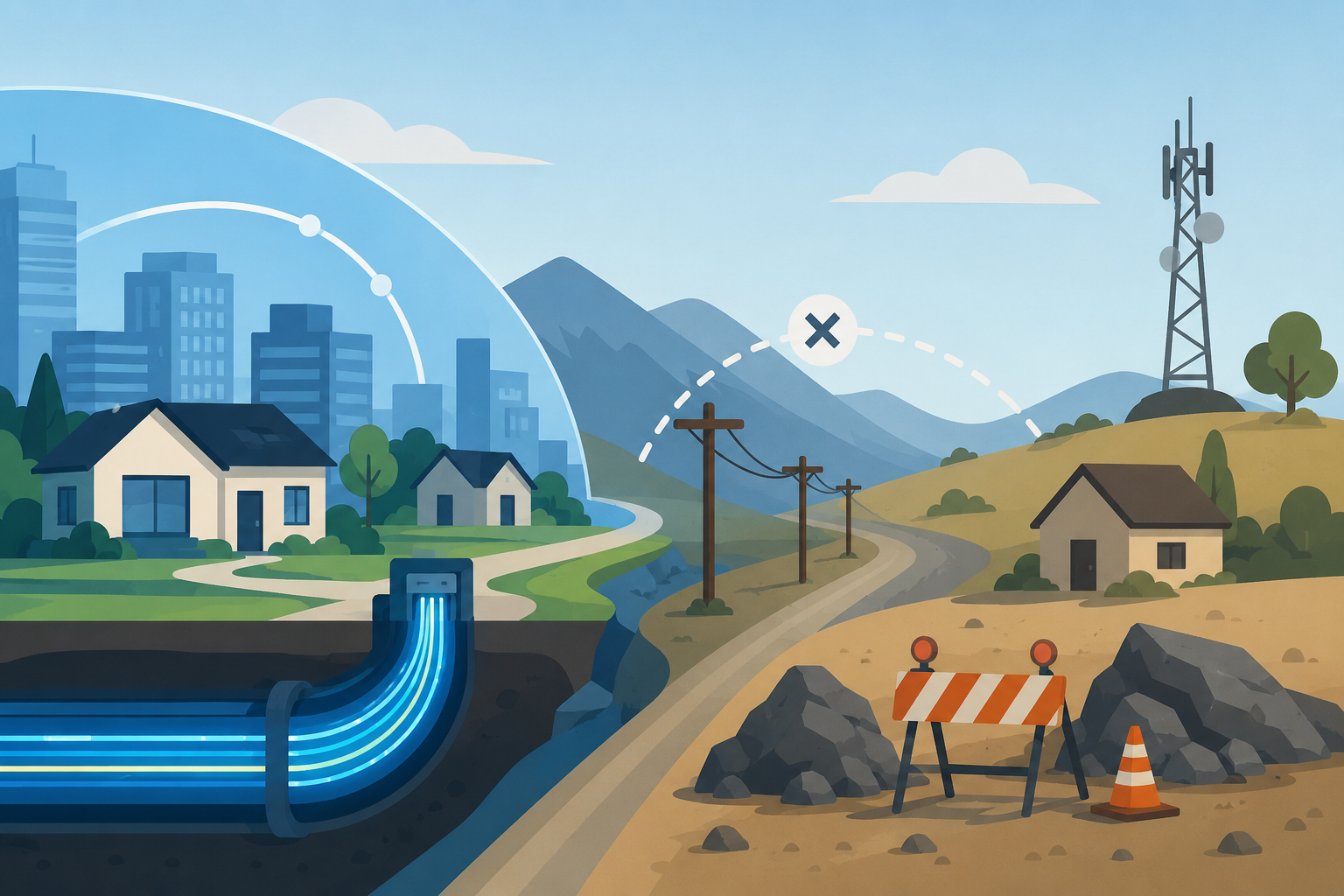
Fiber internet is often described as the gold standard of connectivity. It delivers blazing-fast speeds, low latency, and the kind of reliability modern households and businesses depend on. Yet despite its advantages, large portions of the country still do not have access to fiber internet, especially outside major cities.
This gap is not accidental. It is the result of cost, geography, regulation, and market dynamics that shape how internet infrastructure is built. Understanding why fiber internet is not available everywhere helps set realistic expectations and makes it easier to evaluate current options while waiting for upgrades.
Why Fiber Internet Isn’t Available Everywhere
Fiber expansion is driven by return on investment, not just demand. Even when residents want faster internet, providers must weigh costs, timelines, and long-term profitability before committing to construction.
High Infrastructure Costs
Installing fiber is expensive, particularly when starting from scratch. Unlike cable or DSL, fiber-optic lines often require entirely new infrastructure. Crews must dig trenches, lay conduit, install cables, and restore roads or sidewalks once work is complete.
In rural or semi-rural areas, the cost per household can be extremely high. When homes are spread far apart, providers may spend tens of thousands of dollars just to connect a single address. In some cases, that figure can climb even higher depending on terrain and permitting requirements.
These costs make fiber deployment financially risky unless there is a clear path to recovering the investment over time.
Low Population Density
Population density plays a major role in where fiber gets built first. Urban and suburban areas allow providers to connect hundreds or thousands of customers within a relatively small footprint. This efficiency lowers the average cost per connection and speeds up profitability.
In contrast, sparsely populated areas offer fewer customers spread over a much larger area. Even if every household signs up, the revenue may not justify the upfront expense. As a result, providers tend to prioritize locations where customer volume offsets construction costs more quickly.
This is why many rural communities remain dependent on older technologies despite growing demand for faster internet.
Regulatory and Permitting Challenges
Fiber construction is not just an engineering project; it is also a regulatory one. Providers must secure permits, coordinate with local governments, comply with zoning rules, and often negotiate access to utility poles or rights-of-way.
In some regions, this process can take months or even years. Delays increase project costs and create uncertainty, which can discourage providers from moving forward. Areas with fragmented local regulations or complex approval processes are often slower to see fiber expansion.
Regulatory hurdles may not be visible to residents, but they have a direct impact on deployment timelines.
Existing Broadband Competition
In areas where cable or DSL already provides acceptable service, fiber may not be seen as an urgent upgrade. From a provider’s perspective, replacing a functional network with a more expensive one does not always make immediate business sense.
Many households can stream, work remotely, and browse online using cable connections, even if speeds are not symmetrical. When existing broadband meets basic needs, fiber demand may appear limited on paper, reducing the incentive to invest.
This dynamic is especially common in mid-sized towns where cable infrastructure is already well established.
Geographic and Environmental Barriers
Physical geography can significantly complicate fiber installation. Mountains, rocky soil, dense forests, wetlands, and waterways all increase construction difficulty. In some areas, environmental protections restrict digging altogether.
Extreme weather conditions can also raise maintenance costs, making long-term operation less attractive for providers. These environmental factors often explain why certain regions remain underserved despite nearby areas having fiber access.
When Fiber Internet May Finally Reach Underserved Areas
While challenges remain, fiber expansion is steadily progressing. Several factors are accelerating deployment in places that were previously overlooked.
Government Broadband Funding
Public investment has become one of the biggest drivers of fiber growth. Federal and state programs now recognize broadband as essential infrastructure, similar to roads and electricity.
Funding initiatives help offset the high costs of deployment, making it financially viable for providers to serve rural and underserved communities. These programs reduce risk and encourage long-term investment where it previously did not make sense.
As funding continues to roll out, more regions are being added to fiber expansion plans.
Public-Private Partnerships
Partnerships between governments and internet providers are playing an increasingly important role. In these arrangements, public entities may provide funding, access to infrastructure, or streamlined permitting, while private companies handle construction and operations.
By sharing responsibility, both sides reduce costs and accelerate deployment. These partnerships have proven effective in areas where purely private investment would not have happened.
Lower-Cost Deployment Methods
Advancements in installation techniques are also helping. Methods such as micro-trenching allow fiber to be installed with narrower cuts and less disruption, reducing labor and restoration costs.
Aerial fiber, which uses existing utility poles, is another cost-saving option in suitable areas. As these approaches become more common, they make expansion faster and more affordable.
Over time, these efficiencies increase the number of locations where fiber is economically feasible.
Community Demand and Advocacy
Local demand still matters. Communities that actively express interest in fiber, participate in surveys, or support local broadband initiatives are more likely to attract provider attention.
When providers see clear evidence of adoption potential, the business case for expansion becomes stronger. In many cases, community advocacy has directly influenced build-out decisions.
Internet Options While Waiting for Fiber
For households without fiber access, alternatives can still provide usable performance depending on location and needs.
Fixed Wireless Internet
Fixed wireless uses radio signals transmitted from nearby towers to deliver broadband service. It works well in areas where running cables is difficult or cost-prohibitive.
Speeds can vary based on distance and line-of-sight, but fixed wireless often outperforms older DSL connections and continues to improve as technology evolves.
Satellite Internet
Satellite internet has become more competitive in recent years, particularly with low-earth orbit systems. These services can reach remote areas where no other broadband exists.
While latency and weather sensitivity can still be concerns, satellite internet remains a practical option for rural households needing reliable connectivity.
Cable and DSL Connections
Cable and DSL remain widely available and continue to serve many users effectively. Although they cannot match fiber’s symmetrical speeds, they are often sufficient for streaming, browsing, and remote work.
A deeper understanding of how these technologies compare is outlined naturally within this fiber vs. DSL vs. cable comparison, which explains performance differences without oversimplifying the trade-offs.
Why Infrastructure Choices Matter
The type of infrastructure behind your internet connection directly affects speed, reliability, and scalability. Fiber-optic lines transmit data as light, allowing for higher bandwidth and longer distances without signal loss.
Copper-based systems, which power DSL and traditional cable, rely on electrical signals that degrade over distance. This is why performance varies so widely depending on location.
A closer look at fiber-optic and copper cables highlights why fiber is considered future-proof while older technologies are approaching their practical limits.
The Future of Fiber Internet Access
Fiber internet expansion is gradual, but momentum is building. As funding increases, deployment methods improve, and demand continues to rise, more areas will gain access over time.
For residents waiting on fiber, staying informed about local projects and infrastructure plans can provide insight into when upgrades may occur. In the meantime, evaluating current options ensures you remain connected without unnecessary frustration.
If fiber availability is a priority, checking active fiber internet providers in your area can help identify where service is already live or planned next.
Final Thoughts
Fiber internet is not absent because of lack of interest or awareness. It is limited by cost, geography, and long-standing infrastructure decisions. While those barriers are real, they are slowly being addressed through funding, innovation, and collaboration.
Access may not be immediate for everyone, but the long-term trajectory points toward broader fiber availability. Until then, understanding the landscape helps you make informed choices and set realistic expectations.
Related Posts
 cheap internet plans
mobile phone plans
Broadband Deals
cheap internet plans
mobile phone plans
Broadband Deals
Which Internet Providers Offer a Cheap Mobile Plan?
Discover which internet providers offer a cheap mobile plan when you bundle services. Compare savings, features, and the best options for your budget.
 Broadband Deals
Technology
Broadband Deals
Technology
What Is 5G and Why It Matters for Businesses and Everyday Life
Learn what 5G is, how it works, and why it matters for businesses and consumers. Discover its impact on speed, IoT, automation, and future connectivity.
 Technology
How to Choose High-Speed Satellite Internet for Your Home
Compare the best high-speed satellite internet providers, their features, coverage, speeds, pricing, and tips to choose the right internet service.
 Broadband Deals
cable deal
Broadband Deals
cable deal
How Spectrum Internet Compares to Xfinity, AT&T & HughesNet
Compare Spectrum Internet with Xfinity, AT&T, and HughesNet based on speed, pricing, reliability, technology, and value to choose the right provider.
 cheap internet deals
Best DSL Internet Providers for Reliable Home Internet
Compare the best DSL internet providers, including AT&T, CenturyLink, and Frontier. Learn about speeds, pricing, pros, and how to choose the right plan.