Siri vs Alexa: Which Smart Assistant Fits You Best?
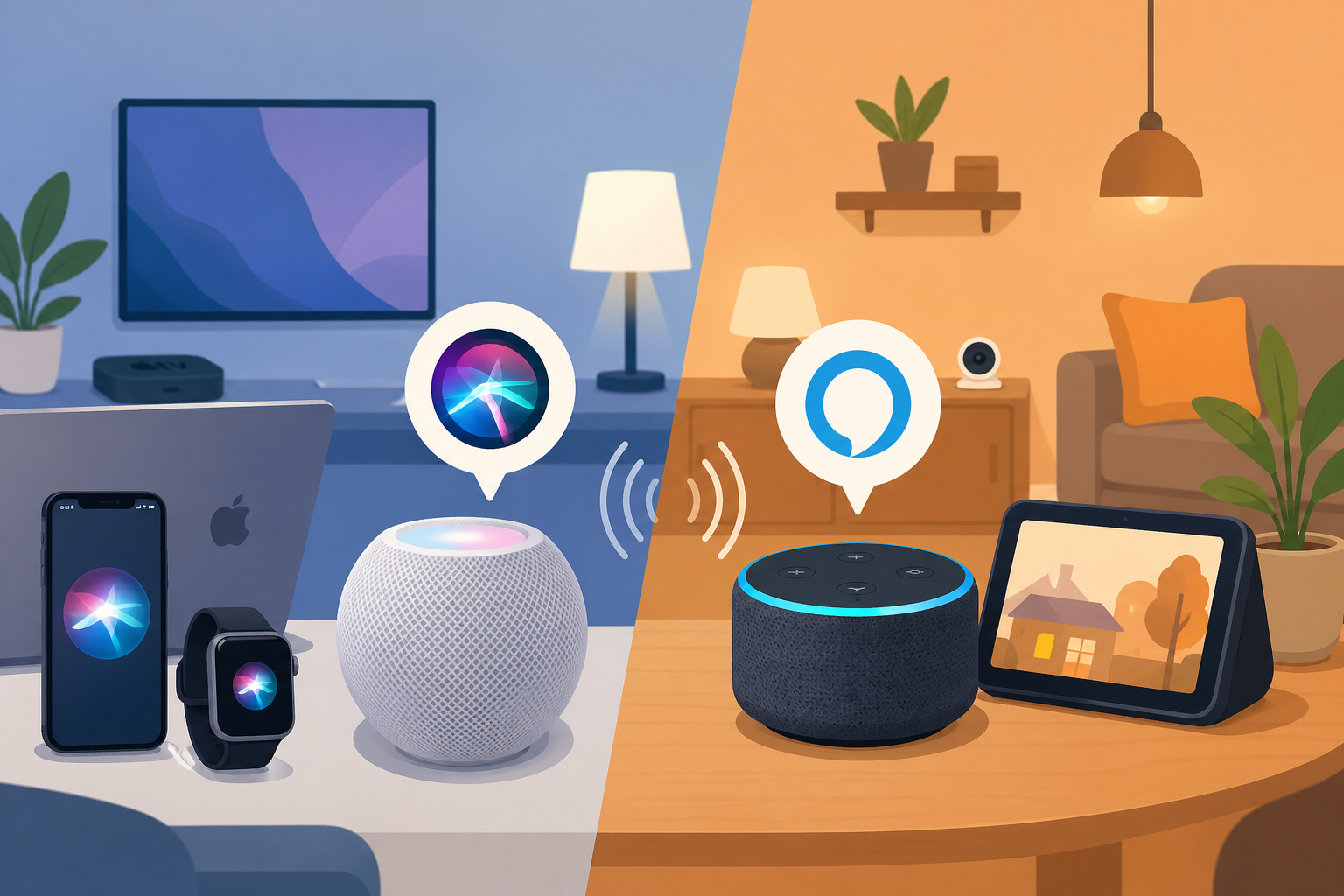
Choosing between Apple Siri and Amazon Alexa usually comes down to one big question: which smart assistant fits better into your daily life?
Both Siri and Alexa can answer questions, control smart home devices, play music, set reminders, manage routines, and make everyday tasks easier. But they are built around very different ecosystems.
Siri works best for people who already use Apple devices. Alexa is often the better fit for smart home users who want wider device support, lower-cost speakers, and more flexible integrations.
Siri vs Alexa: Quick Overview
Siri is Apple’s voice assistant, built into iPhone, iPad, Mac, Apple Watch, Apple TV, HomePod, and CarPlay. Its biggest strength is how smoothly it works across Apple products.
Alexa, created by Amazon, is best known through Echo speakers, Fire TV devices, and a wide range of third-party smart home products. Its biggest strength is smart home control and broad compatibility.
So, when comparing Siri vs Alexa, the better option depends less on which assistant is “smarter” and more on which one works better with the devices you already own.
Which Is Better, Siri or Alexa?
Siri is usually better for Apple users who want privacy, convenience, and smooth device integration. Alexa is usually better for smart home users who want more device options, cheaper hardware, and stronger automation features.
Both assistants can handle everyday tasks well. You can ask either one to check the weather, set timers, create reminders, play music, answer simple questions, and control compatible smart devices.
The difference becomes clearer when you look at your lifestyle. If your phone, laptop, watch, and tablet are all Apple products, Siri feels natural. If your home is filled with smart plugs, lights, speakers, cameras, and entertainment devices, Alexa often feels more practical.
Device Compatibility and Ecosystem
Siri is closely tied to Apple hardware. That is both a strength and a limitation.
If you use an iPhone, Apple Watch, Mac, or HomePod, Siri is already built in. You do not need extra setup for basic voice commands. It works smoothly with Apple apps like Messages, Calendar, Maps, Reminders, and Apple Music.
Alexa, on the other hand, is available on a much wider range of devices. Amazon Echo speakers are usually affordable, and Alexa is supported by many third-party smart speakers, TVs, soundbars, appliances, security cameras, and smart home accessories.
This makes Alexa easier to expand throughout a home without spending heavily on premium hardware.
Smart Home Control
Alexa has a clear advantage in smart home compatibility.
It supports a large number of smart lights, plugs, thermostats, locks, cameras, robot vacuums, and home automation products. Alexa routines are also flexible, allowing users to combine multiple actions into one command.
For example, you can say, “Alexa, good night,” and have it turn off the lights, lock the door, lower the thermostat, and play relaxing sounds.
Siri can also control smart home devices through Apple Home, but the selection is more limited. The experience is excellent when everything is compatible, but it can require more careful product choices.
Voice Recognition and Natural Conversation
Siri often feels more natural for quick, casual commands, especially on iPhone. It understands many everyday requests well and works smoothly with Apple’s built-in apps.
Alexa is powerful, but it can sometimes require more specific wording. Users may need to phrase commands in a clearer or more structured way, especially when using skills or smart home routines.
That said, Alexa is very reliable once routines and devices are set up properly. It may not always feel as conversational as Siri, but it is highly useful for repeated household tasks.
Privacy and Security
Privacy is one of Siri’s biggest advantages.
Apple has built much of its brand around privacy-focused design, and Siri benefits from that approach. For users who care deeply about data protection, Apple’s ecosystem may feel more reassuring.
Alexa is deeply connected to Amazon services, including shopping, entertainment, and smart home features. While Amazon provides privacy controls, users who are sensitive about voice data may prefer Apple’s tighter privacy positioning.
If privacy is your top priority, Siri is the stronger choice.
Music, Entertainment, and Streaming
Alexa works especially well for home entertainment.
It supports several music services and works naturally with Echo speakers, Fire TV, and many third-party audio devices. If you use Amazon Music, Spotify, Audible, or Fire TV, Alexa can feel very convenient.
Siri works best with Apple Music and Apple devices. It can control playback across iPhone, HomePod, Apple TV, and AirPods with very little friction.
For Apple Music users, Siri is excellent. For broader streaming flexibility, Alexa often has the edge.
Shopping and Everyday Convenience
Alexa is better for shopping-related tasks.
Because it is connected to Amazon, Alexa makes it easy to build shopping lists, reorder household items, check delivery updates, and browse products by voice.
Siri can create shopping lists and reminders, but it does not match Alexa’s direct connection to online shopping.
For users who regularly shop on Amazon, Alexa adds a layer of convenience that Siri cannot fully replace.
Cost and Accessibility
Alexa is usually more affordable to get started with.
Amazon frequently offers Echo devices at low prices, making it easy to place Alexa speakers in bedrooms, kitchens, offices, and living rooms.
Siri requires Apple hardware. If you already own an iPhone or Mac, that may not matter. But if you want a dedicated smart speaker, Apple’s HomePod options are typically more expensive than many Echo devices.
For budget-conscious smart home setups, Alexa is usually the more accessible option.
Siri’s Biggest Strengths
Siri works best when it is part of a complete Apple lifestyle.
It is convenient on iPhone, useful on Apple Watch, smooth with CarPlay, and helpful across Apple apps. You can send messages, start calls, set reminders, check directions, and control media without installing anything extra.
Siri also feels more personal on mobile devices. Since it is built directly into iOS, it often feels like a natural extension of the phone rather than a separate assistant.
Alexa’s Biggest Strengths
Alexa shines inside the home.
It is excellent for smart speakers, smart displays, connected devices, household routines, entertainment control, and Amazon shopping. It also offers strong support for third-party services and smart home brands.
Alexa is especially useful for families or households where multiple people use shared devices. A kitchen Echo, for example, can handle timers, music, recipes, lists, weather updates, and smart lighting without anyone needing to pick up a phone.
Siri vs Alexa for Smart Homes
For most smart homes, Alexa is the better choice.
It supports more devices, offers easier expansion, and makes routines simple to use once configured. It is also easier to place Alexa-enabled speakers throughout the house because the hardware is usually more affordable.
Siri is still a strong option if you prefer Apple Home and choose compatible devices carefully. The experience can be clean, secure, and polished, but it may not be as flexible as Alexa’s broader smart home ecosystem.
Siri vs Alexa for iPhone Users
For iPhone users, Siri is the most convenient assistant.
It is already installed, works with Apple apps, and responds quickly to device-based commands. Asking Siri to send a message, call a contact, set a reminder, or navigate with Apple Maps feels simple and direct.
However, iPhone users can still use Alexa through the Alexa app or Echo devices. Many people use Siri on their phone and Alexa at home, which can be the most practical setup.
Final Verdict: Siri or Alexa?
Siri is the better choice if you are invested in Apple products, care strongly about privacy, and want a voice assistant that works smoothly across your personal devices.
Alexa is the better choice if you want a flexible smart home assistant with broad device support, affordable hardware, strong routines, and convenient Amazon integration.
The best answer may not be choosing only one. Siri can handle your personal Apple-based tasks, while Alexa manages your home. Together, they can cover different parts of your daily routine without much overlap.
FAQ
Is Alexa better than Siri?
Alexa is better for smart home control, device compatibility, routines, and Amazon shopping. Siri is better for Apple device integration, privacy, and quick personal tasks on iPhone.
Is Siri more private than Alexa?
Siri is generally the stronger option for privacy-focused users because Apple places more emphasis on privacy and on-device experiences across its ecosystem.
Can Siri control smart home devices?
Yes. Siri can control smart home devices through Apple Home, but the device must be compatible with Apple’s smart home platform.
Can Alexa work on an iPhone?
Yes. Alexa can work on an iPhone through the Alexa app, but it is not as deeply integrated into iOS as Siri.
Which assistant is better for music?
Siri is excellent for Apple Music users. Alexa is more flexible for users who rely on different streaming services and smart speakers.
Conclusion
Siri and Alexa are both capable smart assistants, but they serve different kinds of users.
Siri is polished, private, and deeply connected to Apple devices. Alexa is affordable, flexible, and powerful for smart homes.
If your life revolves around Apple products, Siri will likely feel more natural. If you want to build a connected home with many devices, Alexa is usually the smarter investment.
Related Posts
 Technology
Wifi
mobile phone plans
Technology
Wifi
mobile phone plans
What Is a Mobile Hotspot and How Does It Work?
A mobile hotspot is a portable feature or device that converts a cellular data connection (like 4G LTE or 5G) into a private Wi-Fi network
 Broadband Deals
cable deal
Broadband Deals
cable deal
Xfinity Cable Package Deals That Actually Deliver Value
Discover the best Xfinity cable package deals, compare internet and TV bundles, understand pricing, and choose the right plan for your home and budget.
 Broadband Deals
What Is TDS Internet and Is It Right for Your Home?
Learn what TDS Internet is, how it works, available plans, pricing, speeds, benefits, and how it compares with other internet providers.
 Internet Bundles
Bundle Internet, TV, and Phone Without Overpaying
Learn how to bundle internet, TV, and phone services for the best value. Compare plans, avoid hidden fees, and choose the right package for your home.
 Broadband Deals
cable deal
cheap internet deals
Broadband Deals
cable deal
cheap internet deals
Chicago Neighborhood Internet Guide for Better Connectivity
Explore internet options across Chicago neighborhoods, compare providers, understand speeds, costs, and find the best broadband solution.