What Is the Difference Between 4G, 5G, and 6G?
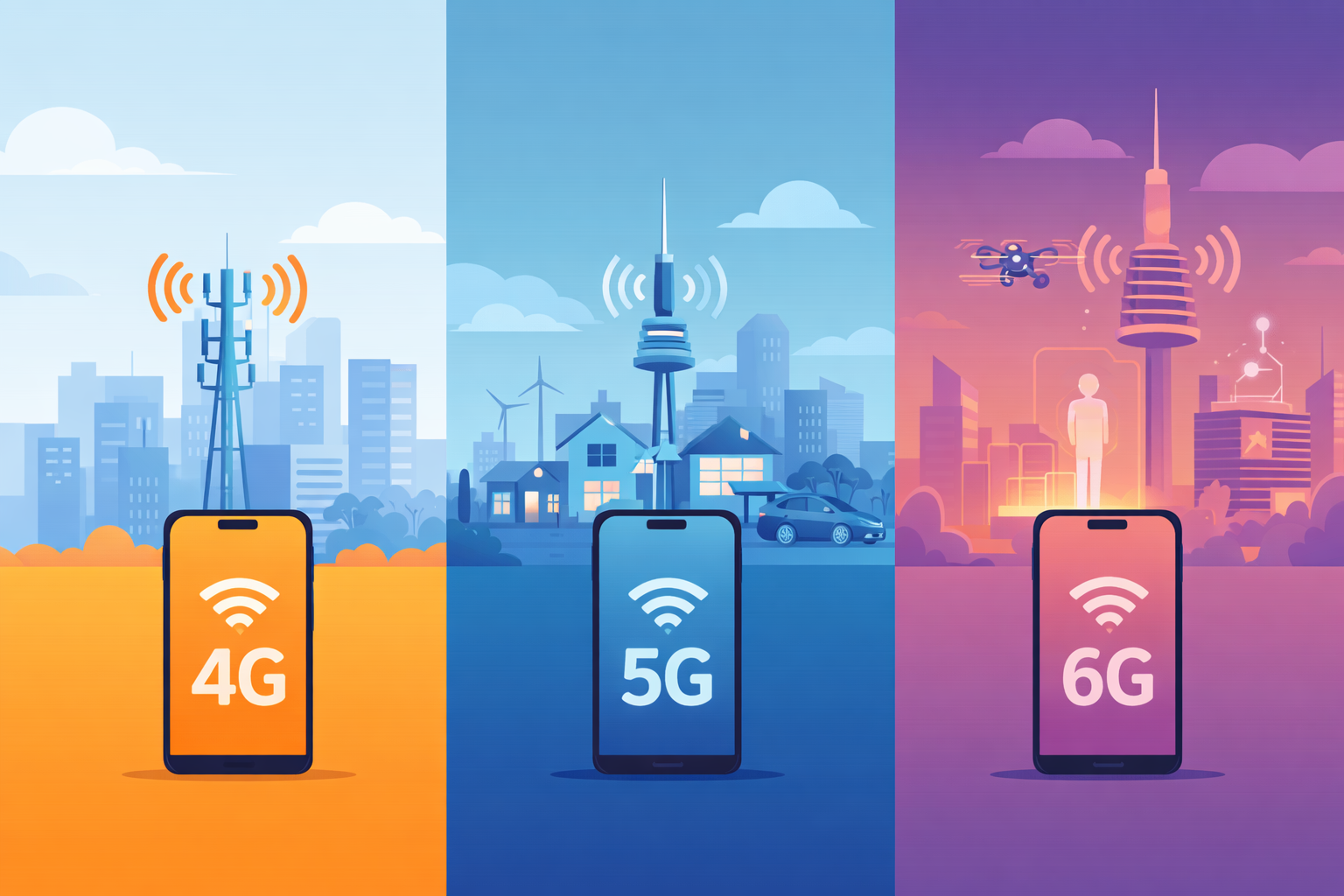
It’s hard to imagine life without mobile internet. We stream our favorite shows, make video calls, shop online, and even work remotely — all from the palm of our hands. But none of this would be possible without the evolution of wireless technology.
Today, we’re transitioning from 4G to 5G, and already hearing about 6G. What exactly separates these generations, and what do they mean for your phone experience? Let’s break it down in simple terms — no jargon, just clear insights.
The Evolution of Mobile Networks
Every “G” in mobile technology stands for “generation.” Each new generation brings improvements in internet speed, capacity, and connectivity — shaping how we live and communicate.
Here’s a quick timeline of how we got here:
- 1G: Analog voice calls, limited range, and no data.
- 2G: Text messaging and digital signals.
- 3G: Early mobile internet and video calling.
- 4G: True high-speed mobile broadband.
- 5G: Lightning-fast data and real-time communication.
- 6G: The future — AI-driven, ultra-fast, and globally connected.
Each new generation not only enhances performance but unlocks new possibilities for industries and consumers alike.
Understanding 4G: The Foundation of Modern Connectivity
When 4G arrived, it completely changed how we used mobile devices. It was the first network fast enough to support HD video streaming, mobile gaming, and cloud-based apps — all at once.
4G technology relies on LTE (Long-Term Evolution), which uses pure data transmission for calls, texts, and internet browsing. That’s why it feels so much faster and smoother than earlier generations.
Key highlights of 4G include:
- Speed: Average download speeds between 20–100 Mbps.
- Latency: Around 30–50 milliseconds.
- Coverage: Strong nationwide availability and reliable performance.
Even today, 4G is the most widely used network worldwide. In areas where 5G isn’t available, your phone automatically switches to 4G to maintain stability.
Exploring 5G: The Power of Real-Time Connectivity
5G isn’t just faster — it’s smarter. It’s designed to handle massive amounts of data, power connected cities, and support technologies like autonomous vehicles and augmented reality.
With speeds up to 10 Gbps, 5G is capable of downloading full-length movies in seconds. But the real magic lies in its low latency — often just 1–10 milliseconds — making real-time communication possible for things like remote surgery or cloud gaming.
Here’s what makes 5G stand out:
- Higher bandwidth for streaming, VR, and large file transfers.
- More stable connections even in crowded areas like concerts or stadiums.
- Greater efficiency, meaning less lag and smoother multitasking.
For most users, the biggest difference you’ll notice is responsiveness. Websites load almost instantly, video calls don’t lag, and apps update seamlessly. It’s the kind of speed that makes technology feel invisible.
Looking Ahead to 6G: The Next Frontier
Even as 5G continues to expand, researchers are already developing 6G — the next great leap in wireless communication. If 5G connects our world, 6G will make it intelligent.
While 6G is still in its early research phase, it’s expected to bring unimaginable speed and precision. Early estimates predict speeds up to 1 terabit per second (Tbps) — that’s 1,000 times faster than today’s 5G.
What We Can Expect from 6G:
- Ultra-fast speeds for real-time holographic communication.
- Near-zero latency under one millisecond.
- AI-powered optimization, where networks learn and adapt automatically.
- Global coverage, connecting urban, rural, and remote areas seamlessly.
6G will likely serve as the backbone for fully immersive technologies like virtual worlds, autonomous transportation, and AI-driven healthcare. Most experts anticipate we’ll start seeing 6G deployments by the early 2030s.
4G vs 5G vs 6G: A Simple Comparison
4G
- Speed: Up to 100 Mbps
- Latency: 30–50 ms
- Capacity: Moderate
- Use Cases: Streaming, mobile apps, web browsing
- Coverage: Widely available
5G
- Speed: Up to 10 Gbps
- Latency: 1–10 ms
- Capacity: High
- Use Cases: Smart cities, IoT, AR/VR
- Coverage: Expanding
6G (Expected)
- Speed: Up to 1 Tbps
- Latency: Less than 1 ms
- Capacity: Massive
- Use Cases: Holograms, AI-driven systems, XR
- Coverage: Global (projected)
As you can see, every new generation multiplies possibilities — not just for smartphones, but for everything connected to them.
Coverage availability for each generation can be better understood by reviewing a detailed coverage map, which shows how 4G and 5G networks are currently deployed across different regions.
What It Means for Everyday Users
For the average smartphone owner, these advancements mean faster streaming, fewer dropped calls, and smarter apps that can respond instantly. But there’s more to it than convenience.
- 4G made mobile data affordable and accessible.
- 5G is enabling a connected ecosystem of devices.
- 6G will fuse digital intelligence into every corner of our world.
In practical terms, that means smoother video calls, smarter smart homes, and faster internet everywhere you go. And as 5G continues to roll out, more people will begin to experience the benefits firsthand.
Final Thoughts
The jump from 4G to 5G — and eventually 6G — isn’t just about speed. It’s about redefining what’s possible with technology.
From watching movies on the go to controlling your home appliances remotely, each generation of mobile connectivity brings us closer to a seamless, always-on world. And with 6G on the horizon, the future of communication looks faster, smarter, and more connected than ever.
Understanding the differences between 4G, 5G, and 6G helps you make smarter choices — whether you’re upgrading your phone, choosing a data plan, or simply curious about where technology is headed.
Related Posts
 Broadband Deals
Technology
Broadband Deals
Technology
What Is 5G and Why It Matters for Businesses and Everyday Life
Learn what 5G is, how it works, and why it matters for businesses and consumers. Discover its impact on speed, IoT, automation, and future connectivity.
 Technology
How to Choose High-Speed Satellite Internet for Your Home
Compare the best high-speed satellite internet providers, their features, coverage, speeds, pricing, and tips to choose the right internet service.
 Broadband Deals
cable deal
Broadband Deals
cable deal
How Spectrum Internet Compares to Xfinity, AT&T & HughesNet
Compare Spectrum Internet with Xfinity, AT&T, and HughesNet based on speed, pricing, reliability, technology, and value to choose the right provider.
 cheap internet deals
Best DSL Internet Providers for Reliable Home Internet
Compare the best DSL internet providers, including AT&T, CenturyLink, and Frontier. Learn about speeds, pricing, pros, and how to choose the right plan.
 Internet Bundles
How to Temporarily Pause Your Internet Service and Save Money
Learn how to temporarily pause your internet service, avoid cancellation fees, save money during travel, and easily restore your connection when needed.